HEALTH BREAKS
Mental wellbeing refers to a person’s condition with regards to their emotional and psychological wellbeing. It affects how we think, feel, and act. It also helps determine how we handle stress, relate to others, and make choices.
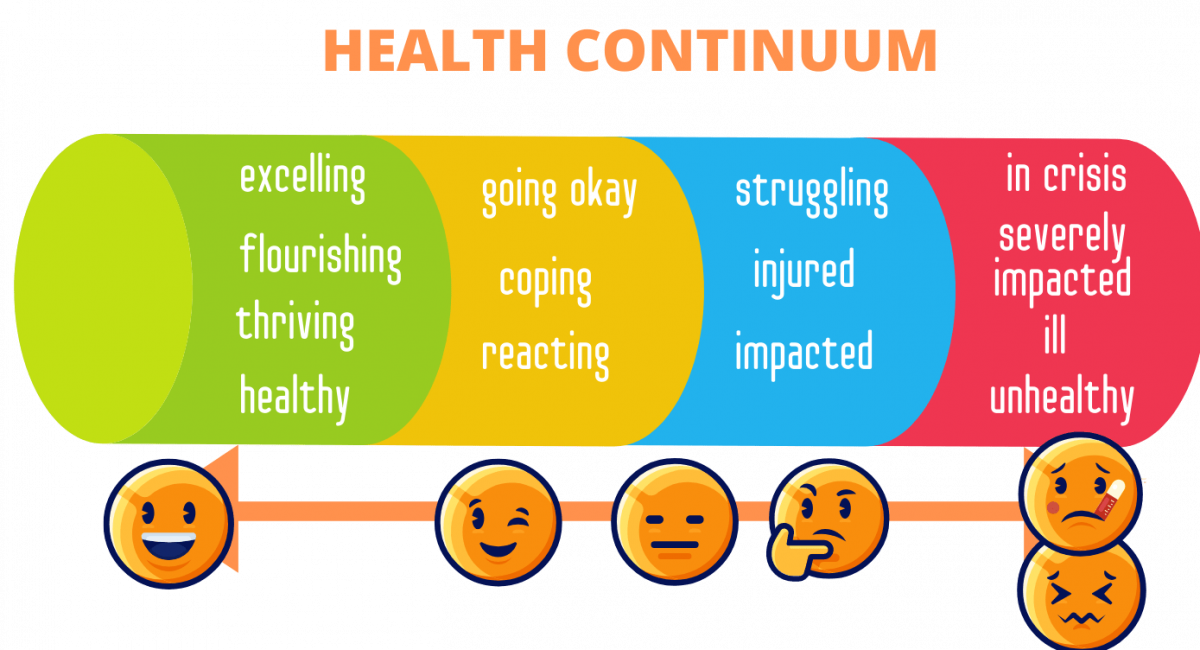
Mental Health exists on a continuum, from positive healthy functioning at one end, to severely impacted daily functioning at the other. It is not fixed or static, but it moves back and forth on your own personal range in response to different stressors.
Having positive mental wellbeing refers not simply the absence of mental health issues, such as depression or anxiety. It relates to a state of well-being where individuals are able to:
- Realise their own potential
- Work productively
- Cope with the normal stresses of life, and
- Make a positive contribution to the community
- Positive mental wellbeing encompasses the way you feel about yourself, and the way you deal with external situations and the quality of your relationships.
It is characterised by the presence of positive characteristics such as a feeling of purpose, contentment, maintaining fulfilling relationships and participating in life to the fullest.
“The Health Breaks Mental Health Wheel breaks down some of the major segments that impact on our mental wellbeing. “
Both positive and negative mental wellbeing can be transient. Influencers within our environment and internal mechanisms in our brain and body can lead to fluctuations in our wellbeing that can be temporary, fleeting or sustaining.
For this reason, it can be powerful to allocate some time and space to self-reflect and explore how you think you are going. Taking a snapshot of your current health status can help you prioritise proactive steps to either maintain or improve your wellbeing.
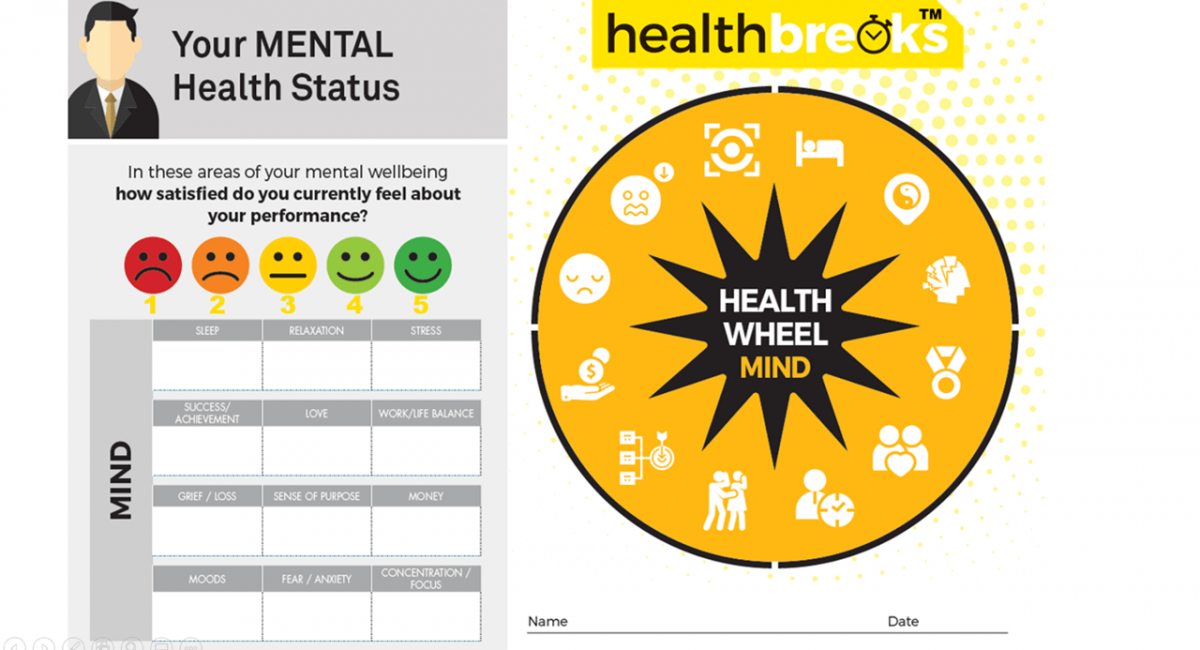
The Health Breaks Mental Health Wheel breaks down some of the major segments that impact on our mental wellbeing. The 12 key segments of our mental health include sleep, time for relaxation, stress, success/achievement, love, work/life balance, grief, sense of purpose, money, moods, and fear/anxiety, concentration/focus.
The Health Breaks Mind Health Wheel takes you through a process of exploring how you feel you are going in each of these areas compared to your level of expectation for yourself. This is a personal measure based on your perspective rather than using standards, scales, and other objective and external measures. Next, the wheel explores how you would prefer to be feeling in each of these areas. The reason why this question is important is that it again considers your own personal expectations you have about your performance and allows you to frame this from your own perspective. The next stage is asking you to consider if areas of your mental wellbeing are important for you to address at the moment and then facilitating the first step to deciding the first action (if any) to take.
This self-exploration is an opportunity for you to self-reflect and determine where you are on the continuum of mental wellbeing. Positioning yourself in a graphic and simple way may reveal to you if it’s appropriate to continue to self-manage (or mis-manage in some cases), or rather, seek some form of external help.
It’s important to note that sometimes mental health can be self managed using strategies like rest and relaxation, and sometimes external and professional health may be crucial. If you feel that your mental wellbeing is suffering and this is beyond your control, please see your GP or talk to a counsellor. Services are also available at Beyond Blue (https://www.beyondblue.org.au/) and Lifeline 13 11 14
In our Health Coaching services at Health Breaks, we partner with you to make small changes you can make to optimise your mental wellbeing. We invite you to register for the Coaching Program – Mentally Well, driven by healthbreaks.app and supported with Coaching check-ins and email support.
Email Health Breaks to find out more: info@enacthealthgroup.com
Performing a daily stretch routine is a great way to release tension caused by stress and to slow your mind and breathing.
Even a few moments spent distracted from negative thoughts, feelings and emotions can play a part in positive self-care.
Perform the stretch with the video below.
Author: Kristin McMaster, Director, Health Breaks – encouraging employees to take a break for their health daily